

EEGNeX
EEGNeX model from Chen et al (2024) [eegnex].
Architecture-only repository. Documents the
braindecode.models.EEGNeXclass. No pretrained weights are distributed here. Instantiate the model and train it on your own data.
Quick start
pip install braindecode
from braindecode.models import EEGNeX

model = EEGNeX(
    n_chans=22,
    sfreq=250,
    input_window_seconds=4.0,
    n_outputs=4,
)
The signal-shape arguments above are illustrative defaults — adjust to match your recording.
Documentation
- Full API reference: https://braindecode.org/stable/generated/braindecode.models.EEGNeX.html
- Interactive browser (live instantiation, parameter counts): https://huggingface.co/spaces/braindecode/model-explorer
- Source on GitHub: https://github.com/braindecode/braindecode/blob/master/braindecode/models/eegnex.py#L16
Architecture
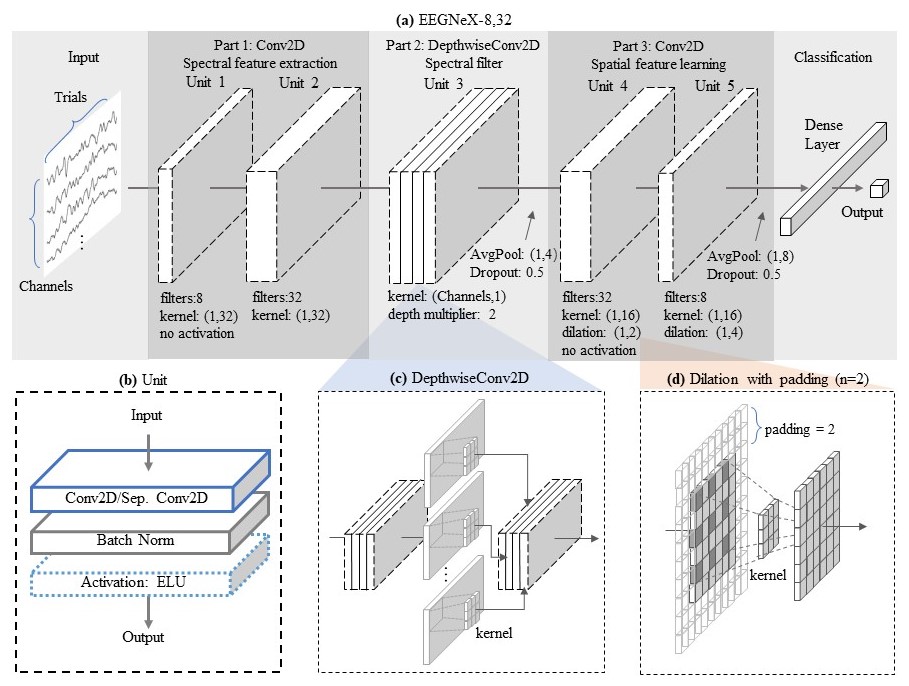
Parameters
| Parameter | Type | Description |
|---|---|---|
activation |
nn.Module, optional | Activation function to use. Default is nn.ELU. |
depth_multiplier |
int, optional | Depth multiplier for the depthwise convolution. Default is 2. |
filter_1 |
int, optional | Number of filters in the first convolutional layer. Default is 8. |
filter_2 |
int, optional | Number of filters in the second convolutional layer. Default is 32. |
drop_prob: float, optional |
— | Dropout rate. Default is 0.5. |
kernel_block_4 |
tuple[int, int], optional | Kernel size for block 4. Default is (1, 16). |
dilation_block_4 |
tuple[int, int], optional | Dilation rate for block 4. Default is (1, 2). |
avg_pool_block4 |
tuple[int, int], optional | Pooling size for block 4. Default is (1, 4). |
kernel_block_5 |
tuple[int, int], optional | Kernel size for block 5. Default is (1, 16). |
dilation_block_5 |
tuple[int, int], optional | Dilation rate for block 5. Default is (1, 4). |
avg_pool_block5 |
tuple[int, int], optional | Pooling size for block 5. Default is (1, 8). |
References
- Chen, X., Teng, X., Chen, H., Pan, Y., & Geyer, P. (2024). Toward reliable signals decoding for electroencephalogram: A benchmark study to EEGNeX. Biomedical Signal Processing and Control, 87, 105475.
- Chen, X., Teng, X., Chen, H., Pan, Y., & Geyer, P. (2024). Toward reliable signals decoding for electroencephalogram: A benchmark study to EEGNeX. https://github.com/chenxiachan/EEGNeX
Citation
Cite the original architecture paper (see References above) and braindecode:
@article{aristimunha2025braindecode,
  title   = {Braindecode: a deep learning library for raw electrophysiological data},
  author  = {Aristimunha, Bruno and others},
  journal = {Zenodo},
  year    = {2025},
  doi     = {10.5281/zenodo.17699192},
}
License
BSD-3-Clause for the model code (matching braindecode). Pretraining-derived weights, if you fine-tune from a checkpoint, inherit the licence of that checkpoint and its training corpus.